
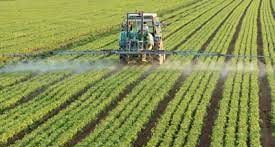
This article was originally published by Michael Snyder at The Economic Collapse Blog under the title: The Global Fertilizer Shortage Is Going To Mean The Spring Planting Season In The Northern Hemisphere Will Be A Total Disaster
Nobody is going to be able to save the spring planting season in the northern hemisphere now, and that is really bad news because, according to the UN, the number of people in the world experiencing acute hunger was already at an all-time high even before the war began. A historic global food crisis has been escalating for years, and now farmers all over the northern hemisphere either can’t get the nitrogen fertilizer that they desperately need or they are paying much more for it. As a result, global food prices will start rising dramatically once harvest season rolls around, and in many impoverished nations, there simply won’t be enough food for everyone.
During normal times, approximately one-third of all globally-traded nitrogen fertilizer travels through the Strait of Hormuz, but right now it can’t get out of the Persian Gulf thanks to the Iranians. Unfortunately, if that nitrogen fertilizer doesn’t get into the hands of farmers in the northern hemisphere within a certain period of time they will completely miss the application window…
The Hormuz Strait carries roughly one-third of global fertilizer trade. If farmers miss the application window, no amount of catch-up planting can recover the loss. The International Grains Council estimates cumulative global wheat and coarse grain output could fall 53 million tons below last season, a shortfall larger than Ukraine’s entire annual grain export volume in a typical year.
According to a former co-chair of the White House’s Supply Chain Disruptions Task Force, the spring fertilizer application window in the northern hemisphere ends next month…
Spring fertilizer application in the Northern Hemisphere runs through June. Parts of Africa are entering the primary planting season now — a critical window for the continent’s most food-insecure populations. A missed window doesn’t delay a harvest — it eliminates it. The shortfall will be invisible until it materializes in spiking prices and empty shelves next fall.
This is the story the Hormuz blockade coverage is missing. The crisis isn’t just raising energy prices — it is breaking food supply chains. The world is facing a slow-motion catastrophe that will not announce itself until it is too late.
That last sentence is so true.
We really are facing a slow-motion catastrophe.
For example, we are being told that fertilizer shortages and high fuel costs have created a “critical threat” to global rice supplies…
Global rice supplies are facing a critical threat this year as farmers across Asia have been forced to reduce planting due to fertilizer shortages and soaring fuel costs, issues exacerbated by the ongoing Iran war. This situation is compounded by the emerging El Nino effect, which is anticipated to further tighten global rice output.
Rice is central to global food security, and even slight disruptions in supply can have wide-ranging effects. Experts warn that rising prices could pressure household budgets, especially in price-sensitive regions like Asia and Africa.
A lot less rice is going to be grown this year.
Meanwhile, the global population continues to grow.
So who is going to have enough rice to eat?
It won’t be the poor.
The wealthy will buy up whatever is available, and it will be at significantly higher prices.
There are close to 1.6 billion people living in Africa, and we are being warned that they will soon be facing soaring prices and food shortages…
The Iran war could have “dramatic consequences”, causing food shortages and price rises in some of Africa’s poorest and most vulnerable communities, the head of the world’s largest fertiliser company has said.
Svein Tore Holsether, the chief executive of Yara International, said world leaders needed to guard against soaring prices and shortages of fertiliser causing a de facto global auction that would leave the poorest countries, particularly in Africa, scrambling for supplies they could ill afford.
Here in the United States, food will still be available.
But it will cost a lot more than it once did, because farmers will be forced to pass along much higher costs for fertilizer and fuel…
Farmers have already begun to feel the effects, with rising fertilizer costs and shortages in supply.
The effects of the global conflict are being felt all over Ohio, Bales said. They have taken a large toll on areas such as north central Ohio and western Ohio, where a large amount of row cropping occurs.
“(Between the) double whammy of fertilizer and fuel, that is definitely going to make some tough decisions going forward,” said Bales.
This crisis is going to hit us a lot harder than most people realize.
One recent survey discovered that a whopping 70 percent of all U.S. farmers are unable to afford all the fertilizer that they need this year…
The result is wreaking havoc on farmers. An agricultural lobbying group, the American Farm Bureau Federation, ran a survey and found that 70% of farmers couldn’t afford all the fertilizer they needed.
“Fertilizer pre-booking rates varied significantly by region, with just 19% of Southern producers reporting fertilizer purchases secured ahead of the season, compared to 30% in the Northeast, 31% in the West and 67% in the Midwest, reflecting differences in planting decision timelines and exposure to recent price increases,” the AFBF wrote. Farm diesel prices, which fuel the heavy machinery used in the industry (other than small-scale farms that don’t produce the majority of food crops in the country) are up 46% since the end of February, according to the organizations.
We have never been through anything like this.
Some farmers have decided to switch to crops that require less fertilizer, and some farmers have decided not to plant at all this season.
In fact, the number of acres of wheat that U.S. farmers are planting this spring will be the fewest that we have seen “since record keeping began in 1919”.
If the Strait of Hormuz reopened tomorrow, and there is no way that is going to happen, it would take weeks for cargo vessels to reach their destinations.
And once the Strait does finally reopen, we are being told that “it could be months before supply chains normalize”…
“Even if the strait reopens, it will take weeks to bring the plants back online and get them running efficiently … it could be months before supply chains normalize,” the United States House Agriculture Committee wrote in a letter to the U.S. Department of Agriculture.
At this point, there is no saving the spring planting season in the northern hemisphere.
It is going to be a disaster.
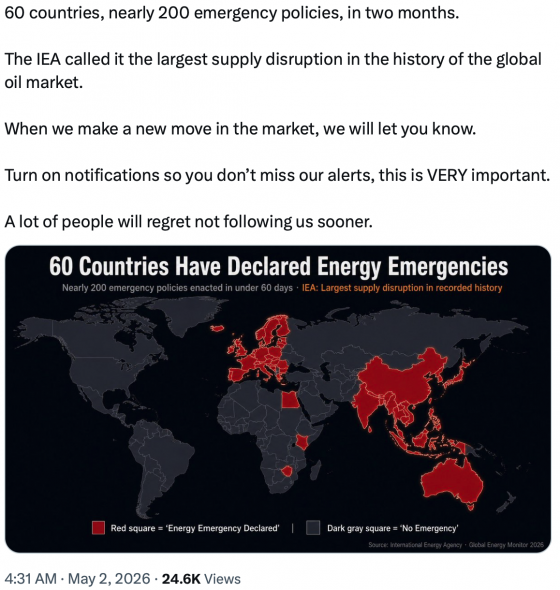
Meanwhile, 60 different nations have implemented emergency energy policies within the past two months…
We desperately need the Strait of Hormuz to be reopened.
But the Iranians are telling us that this is going to be how it is from now on.
They are in full control of the Strait, and it appears that they just attacked yet another cargo ship…
A cargo ship was struck by multiple small craft while sailing near the Strait of Hormuz on Sunday, UK military officials said.
The ship, which was not immediately identified, was hit right off the coast of Sirik, Iran, just east of the strait, according to the British military’s United Kingdom Maritime Trade Operations Centre.
We are still in the very early stages of this nightmare.
If Iran holds the global economy hostage for an extended period of time, we will see economic chaos that is unlike anything we have ever seen before.
But for now most people in the western world are not taking this crisis seriously enough, because they are convinced that it is just a temporary bump in the road.
Michael’s new book, entitled “10 Prophetic Events That Are Coming Next,” is available in paperback and for the Kindle on Amazon.com, and you can subscribe to his Substack newsletter at michaeltsnyder.substack.com.
About the Author: Michael Snyder’s new book, entitled “10 Prophetic Events That Are Coming Next,” is available in paperback and for the Kindle on Amazon.com. He has also written nine other books that are available on Amazon.com, including “Chaos”, “End Times”, “7 Year Apocalypse”, “Lost Prophecies Of The Future Of America”, “The Beginning Of The End”, and “Living A Life That Really Matters”. When you purchase any of Michael’s books, you help to support the work that he is doing. You can also get his articles by email as soon as he publishes them by subscribing to his Substack newsletter. Michael has published thousands of articles on The Economic Collapse Blog, End Of The American Dream, and The Most Important News, and he always freely and happily allows others to republish those articles on their own websites. These are such troubled times, and people need hope. John 3:16 tells us about the hope that God has given us through Jesus Christ: “For God so loved the world, that he gave his only begotten Son, that whosoever believeth in him should not perish, but have everlasting life.” If you have not already done so, we strongly urge you to invite Jesus Christ to be your Lord and Savior today.







0 Comments