
As the G20 meet to determine the fate of the global currency war, Secretary of Treasury Tim Geithner publicly proclaims, yet again, that the United States will not weaken it’s currency on purpose:
The United States of America will never do that. We will never seek to weaken our currency as a tool to gain a competitive advantage and to grow our economy. It’s not an effective strategy for any country, it’s certainly not for the United States. We’ll never do that.
This suggests that Mr. Geithner doesn’t believe that the printing of trillions of dollars and subsequently injecting those dollars into the economy via easy lending and quantitative easing will debase the currency.
And all this time we thought the Fed’s motivation for quantitatively easing and lending money at zero interest was designed to, well, grow the economy. Otherwise, what exactly is the Fed’s motivation behind QE 2.0’s $600 billion dollar cash infusion?
If the policies of this administration and the last are not being pursued to weaken the dollar then we’d ask Mr. Geithner to explain the following US Dollar Index chart:
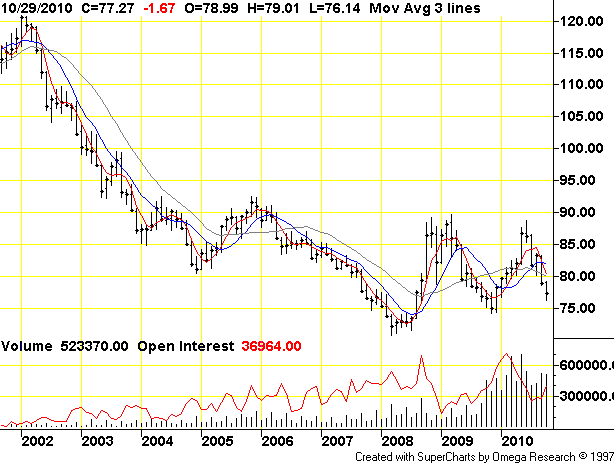 source: Trading Charts
That’s a near ten year decline of the US dollar versus other currencies. If this doesn’t signal a weakening currency, we’re not sure what does.
Geithner continues by sharing his wisdom on why the dollar remains the world’s safe haven asset of choice:
Mostly what you’ve seen when you look at the broader arc of financial markets over the last two and a half years is you’ve seen a period where, when the world was most concerned about the potential risk of global depression, most concerned about the possibility of systemic collapse, you saw the world seek the safety of the risk-free assets of the United States. The dollar generally rose through that period of time.
And as the world has become progressively more confident some of that safe haven inflow has been reversed. That’s been the dominant trend we’ve seen and that’s very encouraging, and not just about people’s overall confidence in the U.S., but a sign of greater confidence that, although we face a lot of challenges in the United States and a lot of challenges globally now, the risks we face are more manageable than those we’ve faced anytime in the last two and a half years.
Mr. Geithner’s assessment that the US dollar was a safe haven asset of last resort is one we can agree with to some extent. In 2008, when the entire worlds’ stock markets started collapsing, investors around the globe shifted their assets into the US dollar. That, along with the fact that most global settlements required US dollars in order to transact, led to a strong rise in the dollar.
When the media and foreign governments convinced people that the green shoots were sprouting and recovery was mere months away, investments did flow out of US dollar assets into riskier equities, forcing stock markets around the world up.
But as we pointed out yesterday, we are nowhere near a recovery, and the fact that Europe is about to fall apart suggests that we have not avoided the depression and systemic collapse Mr. Geithner mentioned.
If European sovereign debt begins to fall apart, country-by-country, we can expect at least one more run-up of the US dollar. Even though investors and foreign politicians are screaming about dollar debasement, if financial markets start to collapse, the dollar will, yet again, likely become the safe haven asset of choice – but only because people will be in panic mode and do what they’ve always done in a stock market collapse.
But it will last only for a little while – and probably for the last time.
Unless you’ve had your head buried in the sand, it’s clear that the US dollar is being debased by the Federal Reserve through quantitative easing. Regardless of what happens in the near-term, the long-term trend depicted in the chart above remains intact and the US dollar will likely continue depreciating.
Most Americans understand this, most foreign leaders understand this, and most foreign financial institutions understand this, as evidenced by Chinese rating agency Dagong recently downgrading the rating of US bonds from AA to A+. We understand that the rating is likely a political move by the Chinese, but nonetheless, it shows that most holders of US debt are fed up with the policies of easy money.
Mr. Geithner may think that current policies will not weaken the dollar, but that is exactly what is happening – and it doesn’t take an economist to see that in not only the US dollar index chart above, but food, energy and commodity prices, as well as what Soverign Man refers to as value deflation.
If the dollar does, once again, become the safe haven asset of last resort in another global meltdown it will only be until foreign holders of US debt reposition themselves to find a better way to preserve wealth. Our guess? They’ll start looking to gold, silver and other commodities that don’t have the risk of a default or forced devaluation of the US dollar.
Watch Tim Geithner:



0 Comments